
If your dog starts limping on a back leg or avoids standing, running, or climbing stairs, there could be a cranial cruciate ligament injury. This very common orthopedic issue in dogs can cause pain, instability, and lasting changes in the knee.
Tibial plateau leveling osteotomy (TPLO) is a surgery that helps stabilize a dog’s knee after a partial or complete cranial cruciate ligament tear.
Understanding what the ligament does, why it gets injured, and how the TPLO surgery works can help you choose the best care for your dog.
What Is the Cranial Cruciate Ligament?
The cranial cruciate ligament (CCL) is an important ligament inside your dog’s knee. Vets call this joint the stifle.
The CCL keeps your dog’s knee stable when it moves. It stops the shin bone (tibia) from sliding forward or twisting too much compared to the thigh bone (femur).
Some people call a CCL injury a torn ACL. The CCL is similar to the anterior cruciate ligament in people, but CCL injuries in dogs often happen differently than ACL injuries in humans.
For people, an ACL tear often happens suddenly during sports. In dogs, the CCL can also tear suddenly, but it usually weakens over time. Research has shown that there is a genetic component to CCL injuries in dog, so they are not always associated with a sudden injury/event. Your dog might start limping or showing signs during normal activities like running or jumping, even if the ligament has been getting weaker for a while.
What Are the Signs of a CCL Injury in Dogs?
Signs of a CCL injury depend on whether the ligament is partially or fully torn. Some dogs suddenly become very lame, while others have stiffness or a limp that gradually gets worse over time.
Possible signs include:
- Limping or avoiding weight on one hind leg
- Difficulty standing up after resting
- Stiffness, especially after activity
- Reluctance to run, jump or climb stairs
- Sitting with one leg extended to the side
- Swelling around the knee
- Decreased interest in walks or play
- Loss of muscle in the affected leg
- A clicking or popping sound from the knee
Some dogs with a partial tear may seem better after resting, but the limp usually returns. This does not mean the problem is fixed. Partial tears can get worse, and ongoing instability can cause inflammation, cartilage damage, and arthritis.
If you hear a clicking sound, it might mean the meniscus, a piece of cartilage in the knee that absorbs shock and helps movement, may be injured. Meniscus damage can happen with a CCL tear and may cause more discomfort.
How Is a CCL Tear Diagnosed?
Your vet will start by reviewing your dog’s medical history and examining the sore leg. They will look for pain, swelling, limited movement, and signs of knee instability.
Some dogs tense their leg muscles during an exam, which can make instability harder to detect. Sometimes, the vet may suggest mild sedation to check the knee more thoroughly and keep your dog comfortable.
X-rays do not show the ligament itself, but they can reveal signs of CCL disease, such as swelling or arthritis. X-rays also help the surgeon check the bones, rule out other problems, and plan for TPLO surgery.
Additional testing may be recommended when another orthopedic or neurological condition is suspected.
Can a Torn CCL Heal Without Surgery?
A torn cranial cruciate ligament usually does not heal on its own. Without a stable ligament, the knee keeps moving abnormally when your dog walks.
Rest, pain medicine, weight control, and rehab can help some dogs feel better and move more easily. Nonsurgical treatment may be an option depending on your dog’s size, age, activity, health, and how unstable the knee is.
However, these treatments do not physically stabilize the knee. Many dogs, especially larger, active ones or those with a very unstable joint, do better with surgery.
The best recommendation depends on each dog. A surgical consultation lets the veterinarian assess your dog and discuss the benefits, limitations, and risks of each option.
What Is TPLO Surgery?
TPLO stands for tibial plateau leveling osteotomy. Instead of replacing the damaged ligament, TPLO changes how the knee works so it stays more stable when your dog puts weight on it.
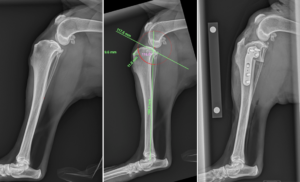
During TPLO surgery, the surgeon makes a curved cut in the top part of the shin bone (tibia). Then, the surgeon rotates this piece to change the slope at the top of the bone, called the tibial plateau. A special plate and screws hold the bone in place while it heals.
Changing the angle of the tibial plateau with TPLO helps stop the abnormal movement that happens when the CCL does not work properly.
The American College of Veterinary Surgeons offers more information about CCL disease, TPLO, and other surgical stabilization procedures.
What Happens During TPLO Surgery?
Each dog’s surgery plan is made for their specific needs, but a typical TPLO procedure includes:
- Preoperative planning: The surgeon reviews the dog’s examination findings and radiographs and calculates the correction required for the individual knee.
- Anesthesia and monitoring: The dog is placed under general anesthesia and closely monitored throughout the procedure.
- Evaluation of the joint: The surgeon assesses the structures within the knee, including the cranial cruciate ligament and meniscus. The surgeon treats damaged tissue as needed.
- Adjustment of the tibial plateau: A curved cut is made in the tibia, and the upper portion is rotated to the planned position.
- Implant placement: A surgical plate and screws stabilize the bone while it heals.
- Postoperative imaging: Radiographs are taken to evaluate the correction and implant placement.
The plate and screws usually stay in place after the bone heals. They do not need to be removed unless a problem with the implant comes up.
This is an example of x-rays taken before surgery (far left), with the planning information (middle) and after surgery (far right).
Which Dogs May Benefit From TPLO?
TPLO is often recommended for medium and large dogs, active dogs, and those with very unstable knees. Some small dogs may also benefit from this surgery.
A dog’s body weight is only one part of the decision. The surgeon will also consider:
- Age and overall health
- Activity level
- Knee anatomy
- Whether the tear is partial or complete
- Degree of instability
- Presence of arthritis
- Possible meniscal damage
- Other orthopedic conditions
- Recovery environment at home
No single surgery is right for every dog. A board-certified veterinary surgeon can examine your dog and explain whether TPLO or another treatment is best.
What Is Recovery Like After TPLO Surgery?
TPLO surgery requires a careful recovery period while the bone heals. Many dogs start using the leg soon after surgery, but this does not mean the bone is fully healed yet.
Your dog’s recovery instructions may include:
- Giving prescribed pain medication as directed
- Keeping the incision clean and dry
- Preventing licking or chewing at the incision
- Restricting running, jumping, stairs and unsupervised activity
- Using a leash for bathroom breaks and approved walks
- Providing secure footing on slippery floors
- Attending scheduled recheck appointments
- Completing follow-up radiographs
- Gradually increasing activity when cleared by the surgeon
- Participating in a recommended rehabilitation program
Recovery time varies for each dog. Your surgeon will decide when your dog can safely do more activity, based on healing, comfort, movement, and follow-up x-rays.
Following the recovery plan helps lower the risk of problems and supports a safe return to normal activity.
Will TPLO Prevent Arthritis?
CCL disease can cause arthritis over time because the joint becomes inflamed and unstable. TPLO surgery helps stabilize the knee, but it cannot reverse arthritis that is already present.
Arthritis can still get worse after surgery, but stabilizing the knee should help your dog move better and feel less pain. Stabilization also helps slow down the progression of arthritis. Keeping your dog at a healthy weight, following rehab advice, and supporting joint health are important even after recovery.
Can a Dog Injure the CCL in the Other Knee?
Dogs with CCL disease in one knee may later have the same problem in the other knee. Not every dog will need surgery on both legs, but watch for limping, stiffness, or changes in movement on the other side. Because this issue has a genetic component, about 50% of dogs will have an issue in the unaffected/normal knee within a year.
Keeping your dog at a healthy weight and in good shape can help reduce stress on the joints. However, CCL disease has many causes and is not always preventable.
When Should You Schedule a Surgical Consultation?
If your dog is limping, suddenly stops using a back leg, or has trouble moving, contact your vet. Getting your dog checked quickly can help find the cause and decide if more tests or a referral are needed.
A TPLO consultation does not mean you have to choose surgery. It gives you a chance to learn about:
- The cause of your dog’s lameness
- Whether the CCL is partially or completely torn
- The amount of instability within the knee
- Whether the meniscus may also be injured
- Available surgical and nonsurgical options
- Expected recovery and home-care requirements
- Potential risks and complications
- The anticipated cost of care
TPLO Surgery in Renton, Washington
Boreal Animal Surgery provides board-certified orthopedic surgery for dogs in Renton, Seattle, and nearby areas in Washington.
Duane Robinson, DVM, PhD, DACVS-SA, evaluates each patient individually and works closely with your family vet during surgery and recovery. Boreal’s surgical suite has advanced anesthesia, monitoring technology, specialized Arthrex® tools, and a dedicated recovery area.
If your dog has a CCL injury or your vet has recommended TPLO surgery, contact Boreal Animal Surgery to schedule a consultation.